
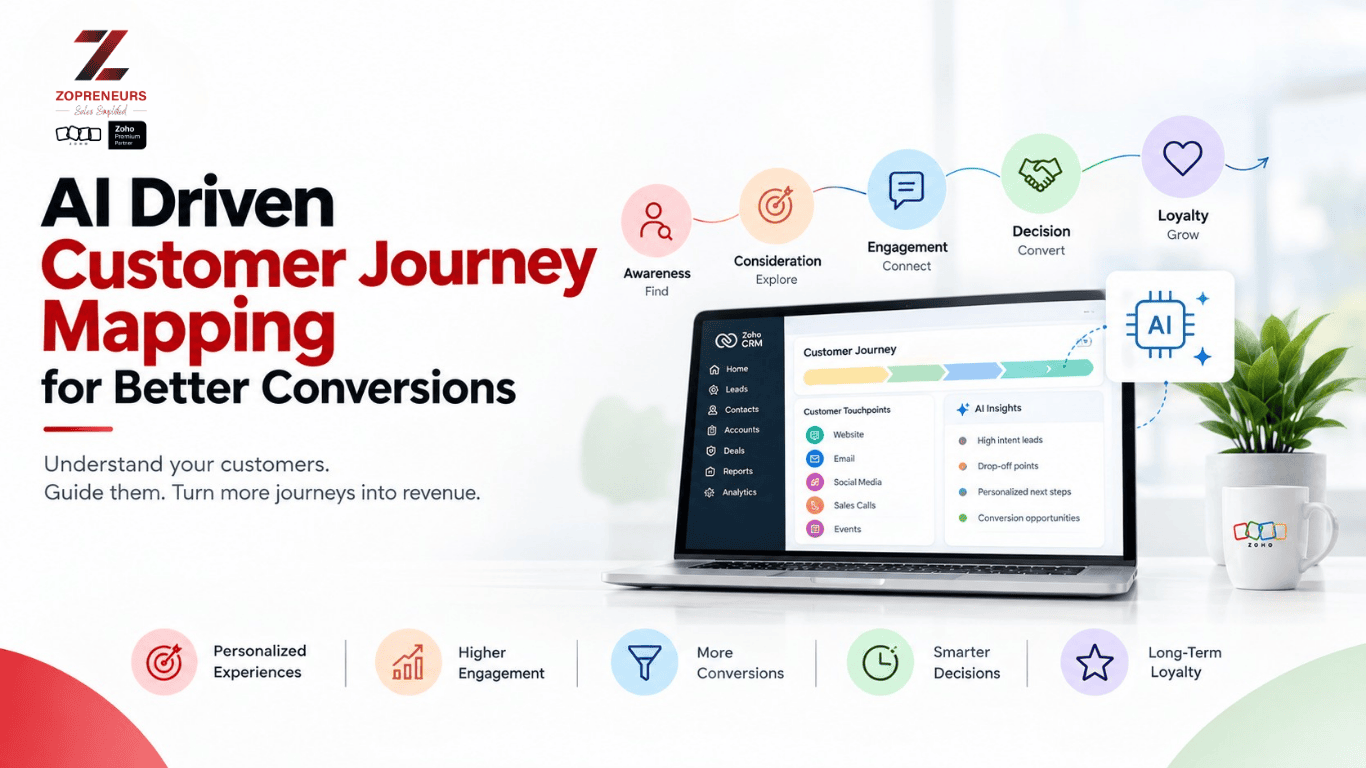
Every customer has a journey before making a purchase. They might discover your business through a Google search, visit your website, read a few reviews, speak to your sales team, and then disappear for weeks before finally deciding whether to buy.
For businesses, understanding this journey is not always easy. Customers interact with brands across multiple channels, and their expectations can change at every stage. A potential buyer who showed strong interest yesterday might lose interest today simply because they did not receive the right information at the right time.
This is where AI-driven customer journey mapping can make a real difference.
By combining customer data, artificial intelligence, and CRM technology, businesses can better understand how customers make decisions, identify where potential sales are being lost, and create more relevant experiences that encourage conversions.
What Is AI-Driven Customer Journey Mapping?
Customer journey mapping is the process of understanding the different interactions a customer has with your business, from the first point of contact to the final purchase and beyond.
Traditionally, businesses have relied on customer surveys, website analytics, sales reports, and feedback from their teams to understand these interactions. While these methods remain useful, they often provide only part of the picture.
AI takes this process further.
It analyses customer behaviour, identifies patterns across different touchpoints, and helps businesses understand what customers might need next. Instead of simply looking at what has already happened, companies can use these insights to make better decisions about how to engage with customers moving forward.
For example, imagine a customer visits your website, downloads a product brochure, and attends a webinar but does not book a consultation. An AI-powered system can help identify this pattern and recommend a relevant follow-up rather than sending the customer another generic promotional email.
The objective is simple: understand your customers better and make it easier for them to take the next step.
Why Traditional Customer Journey Mapping Is No Longer Enough
Customer journeys are rarely straightforward. A customer may discover your brand on social media, compare your services with competitors, return through a search engine, and eventually contact your sales team through WhatsApp.
Keeping track of these interactions manually can quickly become difficult, particularly as your business grows.
Here are some common challenges businesses face.
1. Customer data is scattered across different platforms
Marketing teams may have website analytics and email engagement data, while sales teams work with CRM records and customer conversations. When these systems do not communicate effectively, it becomes difficult to understand the complete customer journey.
2. Follow-ups are not always timely
A customer who requests a quotation expects a response while their interest is high. If the follow-up comes too late, they may already be speaking with another provider.
3. Every customer receives the same communication
Sending identical messages to customers with different needs often leads to poor engagement. Someone researching a solution needs different information from someone who is ready to make a purchase.
4. Businesses struggle to identify where conversions are being lost
A company might generate plenty of enquiries but still struggle to close deals. Without a clear view of the customer journey, it can be difficult to determine whether the problem lies in lead quality, slow responses, ineffective follow-ups, or the sales process itself.
AI can help businesses uncover these gaps by analysing patterns that might otherwise go unnoticed.
5 Ways AI Improves Customer Journey Mapping and Conversions
1. Understand What Customers Actually Do
Customer assumptions can be misleading. A prospect who visits your pricing page several times may be comparing options, looking for reassurance, or preparing to make a purchase. A prospect who downloads a guide may still be in the early research stage.
AI helps businesses make better sense of these behavioural signals by analysing interactions across available data sources.
When connected to the right systems, these insights can help marketing and sales teams understand which content attracts attention, which interactions indicate stronger interest, and where customers tend to lose momentum.
The result is a more informed view of the customer journey, based on behaviour rather than guesswork.
2. Personalise Communication at the Right Time
Customers are more likely to engage with communication that addresses their specific needs.
AI can help segment audiences based on their interests, previous interactions, preferences, and buying behaviour. Businesses can then tailor their messaging to match the customer's stage in the decision-making process.
For example, someone who has just discovered your services might benefit from an educational email explaining the problem you solve. A prospect who has requested a quotation may need a case study, a product demonstration, or a conversation with a sales representative.
This is where personalisation becomes more than simply adding a customer's name to an email. It means delivering information that is relevant to what they are trying to achieve.
3. Identify Leads That Need Immediate Attention
Not every lead has the same level of interest, and sales teams often have limited time to pursue every enquiry equally.
AI-powered lead scoring can help prioritise prospects by analysing factors such as engagement, previous interactions, company information, and other relevant signals. Depending on the system and the quality of the available data, it can help identify leads that are more likely to convert.
Consider a real estate company receiving dozens of enquiries every day. Some prospects may have only viewed a property listing, while others have requested pricing, attended a viewing, and followed up with questions about payment plans.
An AI-supported CRM process can help the sales team prioritise the second group for timely follow-up, while ensuring that other prospects continue to receive appropriate communication.
This allows sales representatives to spend less time sorting through leads and more time having meaningful conversations with potential customers.
4. Spot Drop-Off Points Before They Cost You Sales
One of the most useful applications of customer journey mapping is identifying where potential customers stop moving forward.
Perhaps visitors leave your website before submitting an enquiry. Maybe leads request a demo but never attend. Or perhaps prospects receive quotations but rarely respond.
AI can help analyse historical interactions and highlight recurring patterns associated with these drop-offs.
For instance, a business may discover that leads who do not receive a follow-up within the first working day are less likely to progress to the next sales stage. This insight gives the team a practical opportunity to improve response times and introduce automated reminders.
AI cannot guarantee that every lost opportunity will be recovered. However, it can help businesses identify problems earlier and test changes based on evidence rather than assumptions.
5. Improve the Customer Experience After the Sale
The customer journey does not end when a deal is closed.
Onboarding, customer support, renewals, and ongoing communication all influence whether a customer continues doing business with you.
AI can help identify customers who may need additional support, analyse recurring service issues, and highlight opportunities for relevant follow-ups. For subscription-based businesses, for example, usage patterns and support interactions may help teams identify customers who could be at risk of leaving.
With the right CRM workflows in place, these insights can trigger timely check-ins, support tasks, or customer success activities.
A smoother post-purchase experience can improve customer satisfaction, strengthen relationships, and create more opportunities for repeat business and referrals.
The Role of CRM in AI-Driven Customer Journey Mapping
AI is only as useful as the information and processes supporting it. If customer records are incomplete, sales activities are not updated, or marketing data remains disconnected, even sophisticated AI tools can produce limited results.
This is why CRM plays such an important role.
A well-implemented CRM system brings customer information, sales activities, communication history, and pipeline updates into a more organised environment. AI capabilities can then help teams interpret this information and act on relevant insights.
With a solution such as Zoho CRM, businesses can build structured sales pipelines, automate routine follow-ups, track customer interactions, and improve visibility across the sales process. Depending on the configuration and available features, AI capabilities can further support forecasting, lead prioritisation, and customer engagement.
For businesses looking to improve conversions, the goal should not be to introduce AI simply because it is trending. It should be to connect useful insights with practical actions that help customers move forward.
For example, an AI-generated insight is valuable when it helps a sales representative understand which prospect to contact, what information to share, or which stage of the process needs attention.
Without a clear process for acting on those insights, the technology alone will not deliver the expected results.
How to Get Started With AI-Driven Customer Journey Mapping
You do not need to automate every customer interaction from day one. In fact, starting with a smaller, clearly defined problem is often more effective.
Here are five practical steps to consider.
Step 1: Map your existing customer journey. Identify the key stages customers pass through, from initial awareness and enquiry to purchase and retention.
Step 2: Review your available data. Check whether your CRM, website analytics, email campaigns, and other customer-facing systems provide reliable information about customer interactions.
Step 3: Identify your biggest conversion challenge. Focus on a specific issue, such as unqualified leads, delayed follow-ups, low demo attendance, or quotations that do not progress.
Step 4: Introduce relevant AI and automation capabilities. Use the tools that address your chosen problem, whether that involves lead scoring, behaviour analysis, personalised communication, or automated reminders.
Step 5: Measure the results and improve. Track meaningful metrics such as lead-to-opportunity conversion, response time, demo-to-deal conversion, and sales cycle length. Compare results over time and adjust your approach based on what you learn.
Remember that AI recommendations should be reviewed regularly. Customer behaviour changes, and models can make mistakes. Keep human judgement involved in important customer interactions, and handle personal data responsibly.
Turning Customer Insights Into Better Conversions
AI-driven customer journey mapping is not about predicting every customer decision or replacing your sales team. It is about giving your business a clearer understanding of customer behaviour and helping your team respond more effectively.
When customer data is organised, CRM processes are structured, and AI insights are connected to meaningful actions, businesses can reduce friction across the buying journey. Customers receive more relevant communication, sales teams gain better visibility, and decision-makers can identify opportunities to improve conversion rates.
The most successful approach begins with understanding where your customers struggle and building a process that makes their next step easier.
Ready to Make Your Sales Process Work Smarter?
At Zopreneurs, we help businesses build more structured sales processes with Zoho CRM, automation, and practical sales enablement strategies. Whether you want to improve lead management, streamline follow-ups, or gain better visibility into your sales pipeline, we can help you identify the right opportunities for improvement.
Book your free consultation with Zopreneurs today and discover how a smarter CRM strategy can help you turn more enquiries into meaningful customer relationships and better business outcomes.