
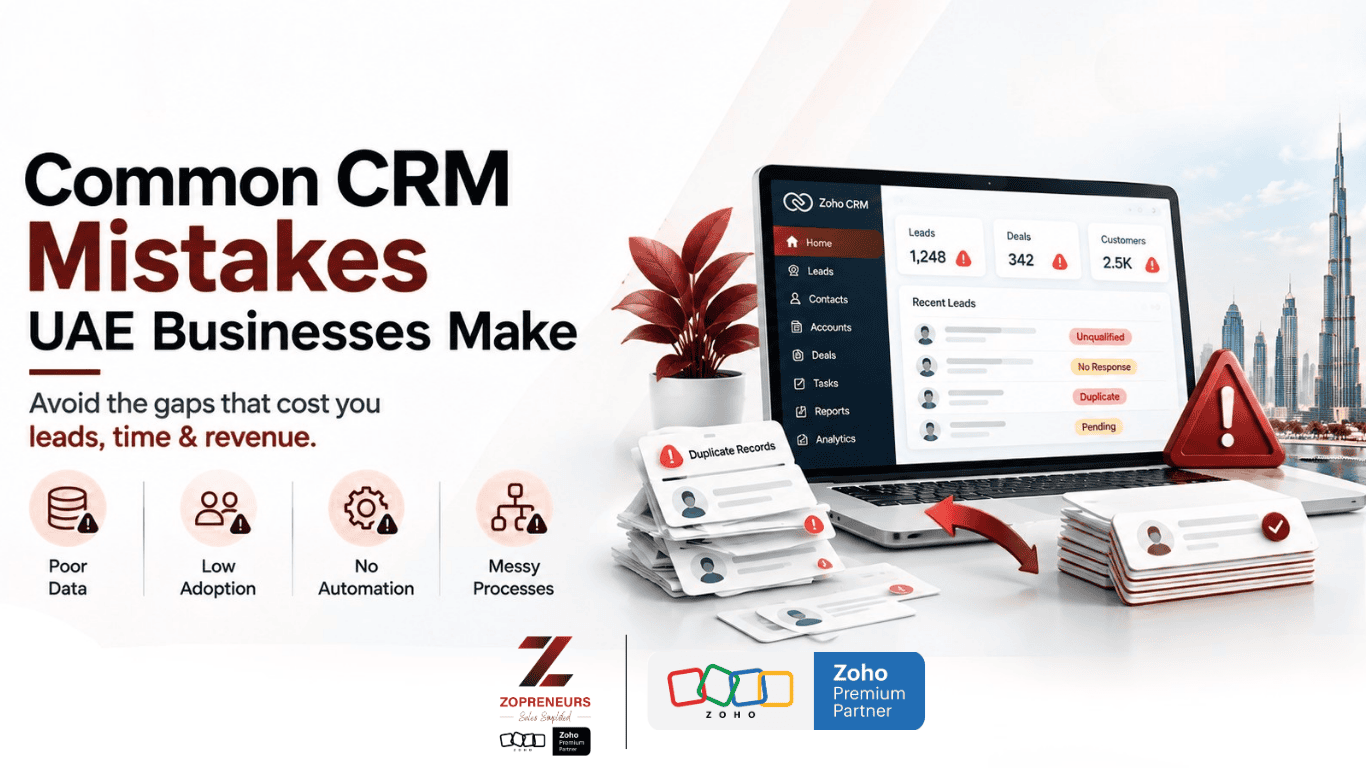
A CRM is supposed to make business easier.
It should help your sales team know who to contact, when to follow up, what stage every deal is in, and what needs to happen next.
Yet, many businesses in the UAE invest in a CRM, spend time implementing it, and still find their sales teams relying on Excel sheets, WhatsApp chats, emails, and manual reminders.
The problem isn't always the CRM.
More often, it's how the CRM has been designed, implemented, and used.
For businesses using Zoho CRM, avoiding a few common mistakes can make a significant difference to sales visibility, productivity, and customer experience.
Let's look at the most common CRM mistakes UAE businesses make—and what you can do instead.
1. Choosing a CRM Without Understanding the Business Process
One of the biggest mistakes businesses make is choosing a CRM first and figuring out their processes later.
A CRM shouldn't dictate how your business operates simply because a particular configuration is convenient.
Before implementing a CRM, businesses should understand:
- How leads enter the business
- How leads are qualified
- Who receives new leads
- How sales opportunities are managed
- What follow-ups are required
- How quotations and proposals are handled
- When a deal is considered won or lost
- What happens after the sale
- What management needs to measure
Without this clarity, your CRM can quickly become a collection of fields and modules rather than an actual sales system.
The better approach
Map the customer journey first. Configure the CRM second.
Your CRM should support your process—not force your team to work around it.
2. Overcomplicating the CRM
More features don't automatically mean a better CRM.
Businesses often add too many:
- Fields
- Modules
- Deal stages
- Workflows
- Mandatory fields
- Approval processes
- Customizations
The intention is usually good: "Let's capture everything."
The result can be a CRM that salespeople don't want to use.
If a salesperson needs to complete 25 fields just to create a lead, they'll eventually start finding shortcuts.
And that's when CRM adoption starts falling.
The better approach
Only capture information that has a clear purpose.
For every field, ask:
"Will this information help us sell, serve the customer, automate something, or make a better decision?"
If the answer is no, reconsider whether you need it.
3. Treating the CRM as a Database Instead of a Sales System
A CRM shouldn't simply store customer names and phone numbers.
It should help your team take action.
A good CRM should tell a salesperson:
Who should I contact today?
Which leads haven't been followed up?
Which deals are at risk?
Which opportunities are close to conversion?
What should I do next?
If your CRM only answers "What information do we have?" but not "What should we do with it?", you're probably not getting its full value.
4. Relying Too Much on Manual Follow-Ups
This is especially common in fast-moving sales environments.
A lead comes in. Someone says they'll call tomorrow. A reminder is added to a personal calendar—or worse, remembered mentally.
Then the follow-up gets missed.
Multiply that across hundreds of leads and opportunities, and you have a serious revenue leak.
With the right CRM automation, many routine activities can happen automatically.
For example:
- Assigning leads to salespeople
- Creating follow-up tasks
- Sending notifications
- Triggering emails
- Alerting managers about stagnant deals
- Updating records
- Moving prospects through defined processes
Automation isn't about replacing your sales team.
It's about making sure your sales team doesn't waste time doing work the CRM can handle.
5. Using WhatsApp Outside the CRM
WhatsApp is an important communication channel for many businesses in the UAE.
But there's a problem when important customer conversations remain scattered across individual phones.
A salesperson may know exactly what happened with a customer—but the business doesn't.
When that salesperson is unavailable, someone else may have no idea:
- What was discussed
- What price was quoted
- What the customer requested
- When they were supposed to follow up
- What stage the opportunity is actually at
Connecting relevant WhatsApp conversations with your CRM workflow can help bring communication and customer records closer together.
The objective isn't to stop using WhatsApp.
It's to stop letting valuable customer information disappear into private conversations.
6. Poor Lead Management
Not every lead deserves the same level of attention.
Yet many businesses treat every enquiry exactly the same.
A lead who downloaded something from your website isn't necessarily equivalent to someone who requested a quotation five minutes ago.
With proper lead scoring and qualification, businesses can prioritize prospects based on factors such as:
- Source
- Engagement
- Industry
- Company size
- Buying intent
- Previous interactions
- Product interest
This allows sales teams to spend more time on opportunities that are more likely to convert.
7. Ignoring Data Quality
A CRM is only as useful as the information inside it.
Duplicate contacts, incomplete records, outdated phone numbers, inconsistent company names, and incorrect deal information can quickly make CRM reports unreliable.
Poor data also creates problems for automation.
For example, if important fields are missing, automated workflows may not trigger correctly.
The better approach
Create clear rules for:
- Data entry
- Duplicate management
- Required information
- Lead conversion
- Record ownership
- Data updates
And review your CRM data regularly.
Clean data isn't an administrative task. It's a business asset.
8. Building Reports That Look Good but Don't Help
A dashboard full of charts can look impressive.
But ask yourself:
Does it help management make a decision?
Your CRM reports should answer practical questions such as:
- How many new leads did we receive?
- Where did they come from?
- What's our lead-to-deal conversion rate?
- How much revenue is in the pipeline?
- Which deals are stuck?
- Which salespeople are performing?
- What is our average sales cycle?
- Why are opportunities being lost?
If your management team still needs multiple Excel sheets to understand sales performance, your CRM reporting probably needs another look.
9. Forgetting the Customer After the Deal Is Won
A CRM shouldn't stop being useful when the deal is marked Closed Won.
The customer's journey continues.
Depending on your business, this could involve:
- Onboarding
- Service requests
- Renewals
- Upselling
- Cross-selling
- Customer communication
- Feedback
- Retention
Your CRM should help create continuity between sales and the teams that manage the customer afterward.
Because the goal isn't simply to close a deal.
It's to build a customer relationship that creates long-term value.
10. Implementing a CRM Without Proper User Training
Even the best CRM implementation can fail if the people using it don't understand why it matters.
Simply giving employees login credentials and a quick demonstration isn't enough.
Your team needs to understand:
- What information they need to enter
- When they need to enter it
- How the CRM helps them
- What processes have changed
- Which tasks are automated
- How their performance is measured
Most importantly, the CRM needs to be easy enough that using it becomes part of their normal workflow.
User adoption is not a training problem alone. It's also a design problem.
How UAE Businesses Can Get More From Their CRM
Avoiding these mistakes starts with one simple mindset shift:
Don't build a CRM around technology. Build it around your business.
Start by understanding your customer journey and sales process. Then configure your CRM around those requirements.
From there, focus on:
- Keeping the CRM simple
- Automating repetitive processes
- Maintaining clean data
- Connecting important communication channels
- Creating useful dashboards
- Training your team properly
- Reviewing and improving the CRM regularly
Your CRM shouldn't become another system your employees have to maintain.
It should become the system that helps them work better.
Need Help Optimizing Your Zoho CRM?
At Zopreneurs, we believe a CRM should do more than store customer information.
As a Zoho Premium Partner, we help businesses design, implement, customize, automate, and optimize Zoho solutions around their actual business processes.
Whether you're starting a new Zoho CRM implementation in the UAE, struggling with CRM adoption, or already using Zoho CRM but feel you're not getting enough from it, the right strategy can make a significant difference.
🚀 Ready to Fix Your CRM?
Don't let CRM mistakes slow down your sales team.
Talk to Zopreneurs today and discover how we can help you build a smarter, more automated, and scalable CRM system for your business.
Zopreneurs — Your Zoho Premium Partner for smarter business growth in the UAE.