
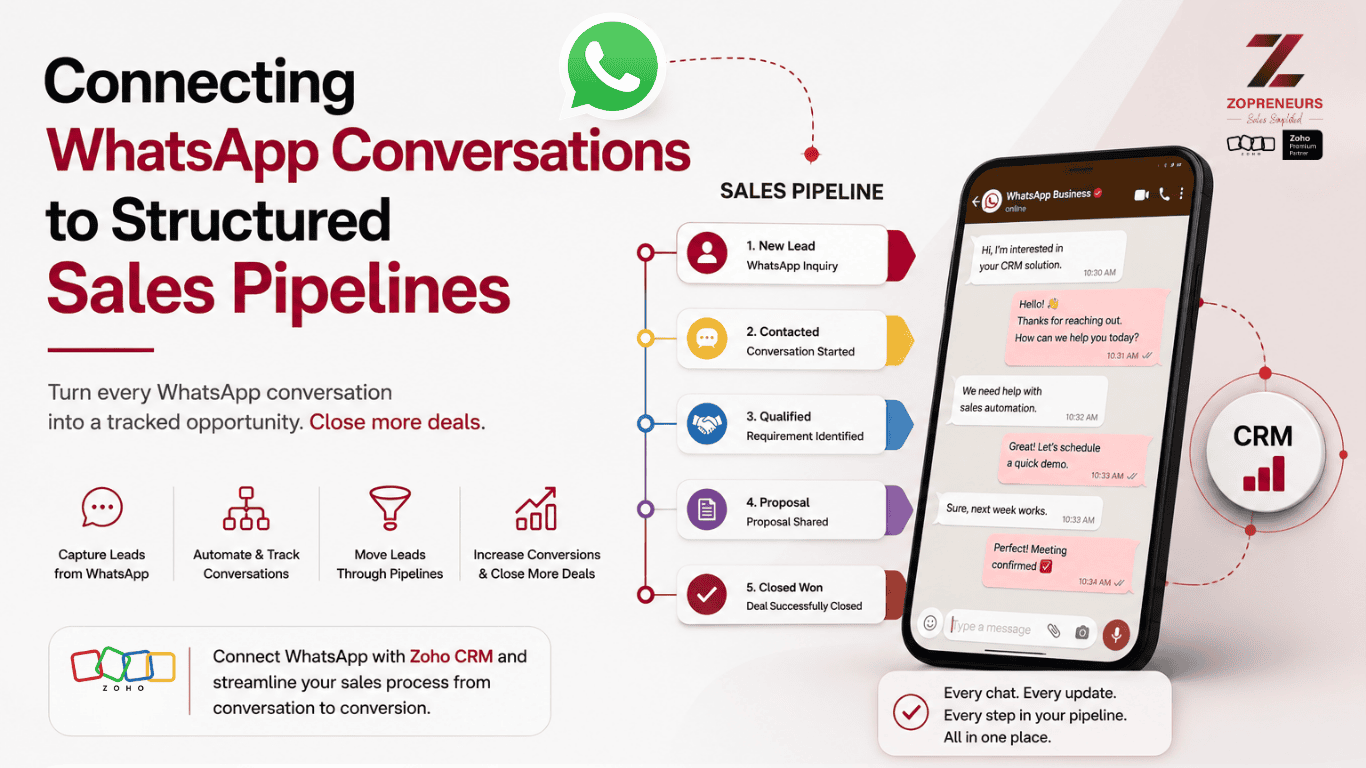
For many businesses, sales conversations begin on WhatsApp.
A customer sends a message asking about a product. A prospect requests pricing. Someone responds to a social media campaign. A sales representative follows up with a voice note. Another team member continues the conversation later.
The conversation keeps moving—but the sales process often does not.
Important customer details remain buried in chat threads. Follow-ups are forgotten. Leads are manually copied into spreadsheets or CRMs. Managers have limited visibility into the sales pipeline.
This is where connecting WhatsApp conversations to structured sales pipelines can make a major difference.
By integrating WhatsApp with a CRM system such as Zoho CRM, businesses can transform informal conversations into organized, trackable sales opportunities.
Why WhatsApp Has Become a Critical Sales Channel
WhatsApp is no longer just a messaging application. For many businesses, it has become one of the fastest ways to communicate with potential customers.
Customers use WhatsApp to:
- Ask product or service questions
- Request quotations
- Share requirements
- Book appointments
- Follow up on proposals
- Send documents
- Negotiate pricing
- Confirm purchases
The challenge is that WhatsApp conversations are usually unstructured.
A typical sales process may look like this:
Customer sends a WhatsApp message → Salesperson replies → Customer asks for pricing → Salesperson sends a quotation → Follow-up is forgotten → Opportunity is lost
Without a structured system, the conversation depends entirely on individual employees remembering what needs to happen next.
That creates a serious gap between customer communication and sales management.
The Problem with Managing Sales Conversations Separately
When WhatsApp and the CRM operate independently, businesses often face several challenges.
1. Important information gets lost
Customer requirements, budgets, timelines and objections may be buried inside long chat conversations.
If a salesperson leaves the company or another team member takes over the account, valuable context may disappear.
2. Follow-ups are easily missed
A salesperson may say:
“I’ll follow up next week.”
But unless that follow-up is recorded somewhere, there is no guarantee it will happen.
Missed follow-ups can quickly turn interested prospects into lost opportunities.
3. Managers lack visibility
Sales managers may know how many deals are in the CRM, but not how many active conversations are happening on WhatsApp.
This creates an incomplete picture of the sales pipeline.
4. Sales teams waste time on manual data entry
Sales representatives may need to:
- Copy customer details from WhatsApp
- Create a CRM contact
- Add a deal
- Enter the deal value
- Update the stage
- Set a follow-up reminder
When this happens repeatedly, sales teams spend valuable time on administration instead of selling.
What Happens When WhatsApp Is Connected to a CRM?
When WhatsApp conversations are connected to a CRM such as Zoho CRM, the sales process becomes much more structured.
Instead of treating WhatsApp as a separate communication tool, businesses can connect conversations to the complete customer journey.
For example:
A customer sends a message
A potential customer contacts your business through WhatsApp.
The conversation becomes a lead
The customer can be added to the CRM with important information such as:
- Name
- Phone number
- Company
- Requirements
- Source
- Lead status
The lead enters the sales pipeline
If the prospect shows genuine interest, the lead can be converted into a sales opportunity.
The opportunity can then move through defined stages such as:
New Lead → Qualified → Proposal Sent → Negotiation → Closed Won
Follow-ups become trackable
Instead of relying on memory, the salesperson can schedule:
- Follow-up calls
- WhatsApp messages
- Meetings
- Proposal reminders
Managers gain visibility
Sales managers can see:
- Which leads are actively engaging
- Which opportunities need follow-up
- Which deals are stuck
- Which sales representatives are handling conversations
- How many conversations are converting into revenue
This creates a direct connection between conversation and conversion.
From “Chat” to “CRM Record”
One of the biggest advantages of integrating WhatsApp with a CRM is the ability to turn conversations into structured customer records.
Consider this example.
A customer messages:
“Hi, I’m interested in your CRM solution. We have a team of 25 people and need automation. Can you share the pricing?”
This message contains valuable sales information:
- Product interest
- Company size
- Business requirement
- Potential buying intent
Without a CRM connection, this information may remain inside a chat.
With a connected system, it can become part of a structured customer record.
The sales team can then:
- Create or identify the contact
- Add the company information
- Record the customer requirement
- Create an opportunity
- Assign a sales owner
- Schedule the next action
- Track the opportunity through the pipeline
The result is simple:
A WhatsApp conversation becomes a measurable sales opportunity.
Connecting WhatsApp to Sales Pipeline Stages
A structured sales pipeline gives every opportunity a clear position.
For example:
Stage 1: New Enquiry
The customer has started a conversation but has not yet been qualified.
Stage 2: Qualified Lead
The sales team understands the customer's needs and confirms that there is a genuine opportunity.
Stage 3: Discovery or Consultation
The sales team learns more about the customer's requirements, budget and timeline.
Stage 4: Proposal Sent
A quotation or proposal has been shared.
Stage 5: Negotiation
The customer is actively discussing pricing, features or terms.
Stage 6: Closed Won
The customer becomes a paying customer.
Stage 7: Closed Lost
The opportunity does not move forward.
By connecting WhatsApp conversations to these stages, sales teams can understand where every customer stands.
This is much more effective than simply searching through chat messages to remember what happened.
Automating Follow-Ups from WhatsApp Conversations
One of the biggest reasons businesses lose sales is not because customers were uninterested.
It is because follow-ups were missed.
Imagine a customer says:
“I need to discuss this with my management team. Please contact me next week.”
Without a structured CRM system, the salesperson may forget.
With CRM automation, the next follow-up can be created immediately.
The system can help the sales team:
- Create a follow-up task
- Set a reminder
- Assign the task to the right salesperson
- Trigger an automated message
- Update the opportunity stage
- Notify managers when an opportunity is inactive
This ensures that the next step is not dependent only on memory.
Turning WhatsApp Data into Sales Insights
When conversations are connected to structured CRM data, businesses can gain insights that are difficult to obtain from WhatsApp alone.
For example, companies can analyze:
- Lead sources
Which campaigns generate the most WhatsApp enquiries?
- Response performance
How quickly does the sales team respond to new conversations?
- Conversion rates
How many WhatsApp conversations become qualified opportunities?
- Pipeline performance
Which stages have the highest drop-off?
- Sales performance
Which sales representatives are converting the most opportunities?
- Customer behaviour
What questions and objections appear most frequently?
These insights help businesses move from simply managing conversations to improving the entire sales process.
WhatsApp + CRM + AI: The Next Step in Sales Automation
The combination of WhatsApp, CRM and AI can take sales automation even further.
AI can help businesses:
- Identify high-intent conversations
- Summarize customer discussions
- Detect buying signals
- Prioritize leads
- Suggest follow-up actions
- Identify customer objections
- Analyze conversation sentiment
- Recommend the next best action
For example, a customer who asks:
“What is the implementation timeline?”
may have stronger buying intent than someone who simply asks:
“How much does it cost?”
AI can help sales teams identify these signals faster.
Instead of manually reading every conversation, sales teams can focus their attention on the prospects most likely to convert.
The Goal Is Not More Messages. It Is Better Sales Visibility.
Connecting WhatsApp to a CRM is not simply about sending more automated messages.
The real goal is to create a connected sales system.
Your customer may begin their journey on WhatsApp, but the sales process should not remain trapped inside the chat.
A structured system allows your business to connect:
Conversation → Customer Data → Sales Opportunity → Follow-Up → Pipeline Stage → Revenue
This creates a complete view of the customer journey.
For growing businesses, this can lead to:
- Fewer missed opportunities
- Faster response times
- Better follow-up consistency
- Less manual data entry
- Improved sales visibility
- More organized customer information
- Better conversion tracking
How Zopreneurs Can Help Your Business Connect WhatsApp and CRM
At Zopreneurs, we help businesses build connected sales systems using the Zoho ecosystem.
As a Zoho Premium Partner in Dubai and the UAE, we help businesses connect their customer conversations, CRM data, automation and sales processes into one organized system.
Whether your business is currently managing customer enquiries through WhatsApp, spreadsheets or multiple disconnected tools, the right CRM strategy can help you create a more efficient and scalable sales process.
The objective is simple:
Every conversation should have a next step.
Every opportunity should have an owner.
Every follow-up should be trackable.
Ready to Turn WhatsApp Conversations into Sales Opportunities?
Don't let valuable customer conversations get lost in chat history.
Connect your WhatsApp conversations to a structured CRM sales pipeline and give your sales team the visibility, automation and organization they need to close more deals.
Talk to Zopreneurs today and discover how we can help you connect WhatsApp, Zoho CRM and your sales process.
Zopreneurs — Your trusted Zoho Premium Partner in Dubai and the UAE.
Start building a smarter, more connected sales pipeline today.