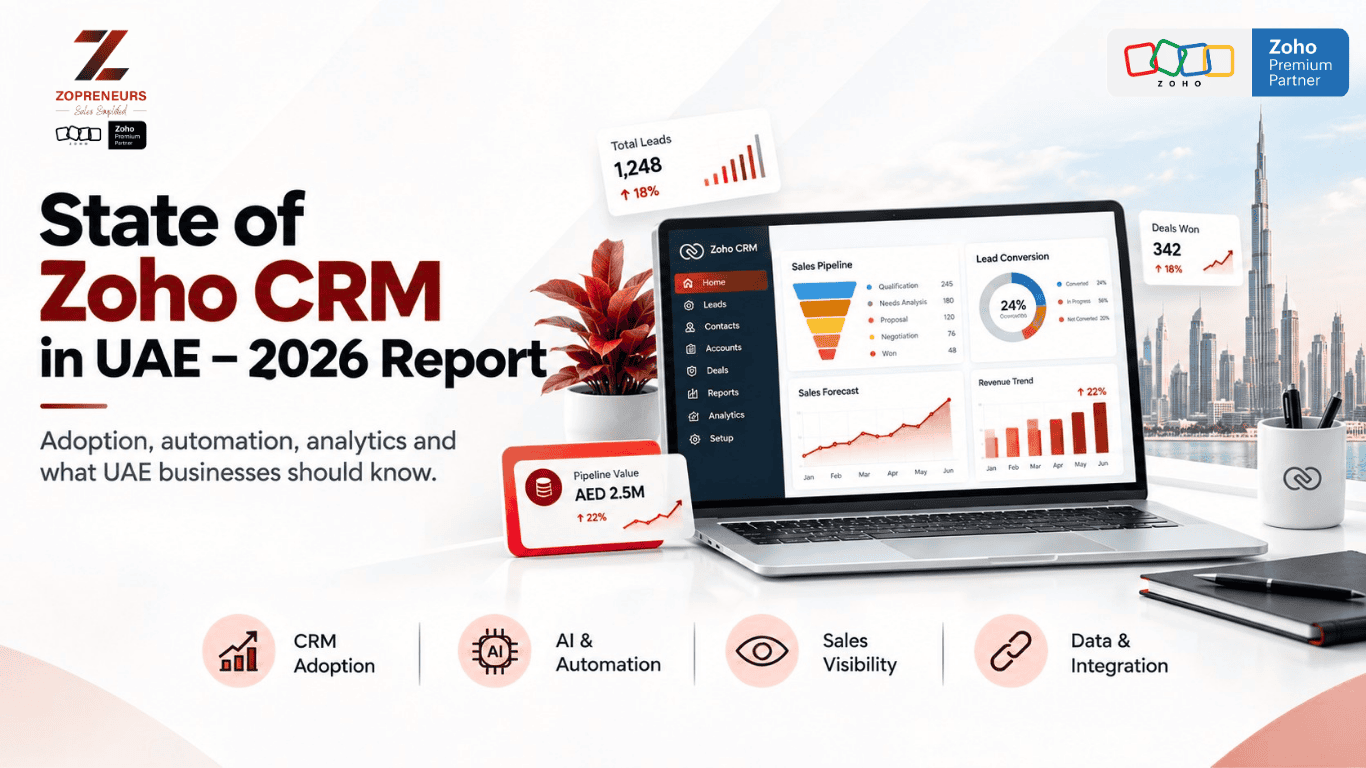
The UAE's business environment is evolving rapidly. From Dubai's competitive real estate market to Abu Dhabi's expanding enterprise ecosystem, businesses are under increasing pressure to respond to customers faster, improve sales productivity, and make decisions based on reliable data.
Yet many organisations continue to manage customer relationships across spreadsheets, email inboxes, WhatsApp conversations, and disconnected business applications.
The result? Missed follow-ups, inconsistent customer experiences, limited visibility into sales pipelines, and revenue opportunities that slip through the cracks.
This is where Zoho CRM is becoming an important part of the conversation around sales transformation in the UAE.
In 2026, the conversation is no longer simply about adopting CRM software. It is about building a connected sales process, using artificial intelligence (AI) intelligently, automating repetitive work, and creating a reliable view of every customer interaction.
Zoho has also strengthened its regional presence. In January 2026, the company announced the opening of new data centres in Abu Dhabi and Dubai, expanding its local cloud infrastructure. This is a significant development for organisations evaluating cloud solutions and local data-hosting options.
This report explores the key developments shaping Zoho CRM in the UAE in 2026, the challenges businesses face, and the practical steps organisations can take to get more value from their CRM investment.
1. The State of CRM Adoption in the UAE: From Contact Management to Sales Intelligence
For many businesses, the first reason to implement a CRM is straightforward: bring customer information into one place.
But as organisations grow, the limitations of basic contact management become increasingly apparent.
Sales managers need to know which leads have been contacted, which opportunities are progressing, why deals are getting delayed, and where their teams need support. Business owners need reliable forecasts, while marketing teams need to understand which campaigns are generating qualified opportunities.
A well-implemented CRM can help connect these requirements.
The shift towards structured sales processes
Businesses evaluating Zoho CRM in the UAE are increasingly looking beyond storing names, phone numbers, and email addresses. The more important questions are:
Can we track every enquiry from its source to closure?
Can we automatically assign leads to the right salesperson?
Can we make sure follow-ups happen on time?
Can managers identify deals that have stalled?
Can we measure conversion rates across sales stages?
Can we connect marketing activity with actual revenue outcomes?
These questions reflect a broader business need: moving from reactive selling to a structured, measurable sales operation.
For growing SMEs, real estate companies, trading businesses, service providers, and other sales-driven organisations, this shift can make CRM a core business system rather than another software subscription.
Why spreadsheets and disconnected tools become limiting
Spreadsheets can work well when a business has a small number of leads and a simple sales process.
However, when enquiry volumes increase, several problems can emerge:
Multiple employees maintain different versions of customer information.
Leads remain unattended when responsibilities are unclear.
Managers depend on manual updates for sales reports.
Customer conversations become difficult to track across channels.
Business owners lack a consistent picture of pipeline performance.
Zoho CRM can centralise customer records, sales activities, deal stages, and reporting. With the right configuration, it can also automate routine tasks and help teams follow a consistent process.
The key takeaway: CRM adoption should not be measured by how many records a company stores. It should be measured by how effectively the system helps its people convert opportunities into customers.
2. AI-Powered CRM Is Moving from Experimentation to Practical Sales Support
Artificial intelligence is one of the most important developments shaping CRM in 2026.
Businesses are exploring how AI can help employees work faster, understand customer behaviour, identify sales opportunities, and reduce repetitive administrative tasks.
Zoho CRM includes Zia, its AI assistant, which supports capabilities such as predictions, recommendations, automation suggestions, and AI-assisted productivity. Feature availability depends on the edition, configuration, and supported data centre.
How AI can improve sales performance
When appropriately configured and supported by reliable data, AI can help sales teams in several ways.
1. Prioritising promising leads
Lead scoring and predictive capabilities can help teams identify prospects that may be more likely to convert, allowing salespeople to prioritise their efforts.
2. Identifying deals at risk
Predictive insights and pipeline analysis can help teams identify opportunities that may require attention before they are lost.
3. Reducing administrative work
AI-assisted summaries, writing support, and automation can reduce the time spent preparing routine communications and reviewing customer records.
4. Improving sales decisions
Insights drawn from CRM data can help managers identify trends, evaluate pipeline performance, and determine where additional attention may be required.
5. Supporting more relevant customer communication
When used with appropriate human review, AI-assisted communication can help teams prepare contextual follow-ups and respond more consistently.
What changed in Zoho CRM in 2026?
Zoho's first-quarter 2026 product update introduced enhancements across sales productivity and AI-assisted work. These included Workqueue, which centralises activities requiring attention, improvements to AI-assisted record and template workflows, and the ability to take actions from configured Zia insights.
The reality check: AI needs a good sales process
AI alone cannot fix a poorly structured CRM.
If lead records are incomplete, deal stages are inconsistent, or employees fail to update activities, AI-generated insights may be less useful.
Before investing heavily in advanced AI features, businesses should establish clear sales stages, reliable data-entry practices, appropriate permissions, and measurable sales KPIs.
The most effective approach is to build a structured CRM foundation first and introduce AI where it solves a clearly defined business problem.
3. CRM Automation Is Becoming Essential for Sales Teams
Manual follow-ups are one of the most common weaknesses in sales operations.
A prospect submits an enquiry. Someone forwards it to a salesperson. The salesperson intends to call but gets occupied with another task. A few days later, the lead has gone cold.
This is not always a sales talent problem. Often, it is a process problem.
Zoho CRM workflow automation can help businesses establish consistent rules for assigning leads, scheduling activities, sending notifications, updating fields, and triggering follow-up processes.
What can businesses automate with Zoho CRM?
Depending on the business requirements and configuration, common automation opportunities include:
Lead assignment: Route incoming enquiries to the appropriate salesperson or team.
Follow-up reminders: Create tasks and notifications to reduce missed activities.
Lead nurturing: Trigger relevant communications based on defined criteria and customer interactions.
Deal-stage updates: Apply rules to standardise parts of the sales process.
Internal notifications: Alert managers when important opportunities require attention.
Sales reporting: Use dashboards and reports to monitor performance without relying entirely on manual updates.
Example: A more structured lead-to-closure process
Consider a UAE service company receiving enquiries through its website, referrals, and digital marketing campaigns.
Without a structured system, employees might track each enquiry differently. Some prospects receive immediate responses, while others wait several days.
With a properly configured CRM, the business can establish a repeatable workflow:
Capture an enquiry and record its source.
Assign the lead to the appropriate salesperson.
Create a follow-up task with a defined deadline.
Track the outcome of the initial conversation.
Move qualified prospects into the appropriate deal stage.
Notify the responsible manager when an opportunity becomes inactive.
Review conversion rates and identify recurring bottlenecks.
Automation does not replace salespeople. It helps create an environment where salespeople can focus on conversations, relationship-building, and closing deals instead of remembering every administrative task.
4. WhatsApp, Email, and CRM Integration: Connecting Customer Conversations
WhatsApp plays an important role in everyday business communication across the UAE. Businesses also rely heavily on phone calls, email, websites, and social media to attract and engage prospects.
The challenge is that customer information can become fragmented when these channels operate independently.
A salesperson may have important context in a WhatsApp conversation, a quotation in email, and the opportunity details in a separate spreadsheet.
This creates unnecessary friction for sales teams and makes it harder for managers to understand what is happening across the pipeline.
Why connected communication matters
Integrating Zoho CRM with appropriate communication tools can help businesses create a more organised customer journey.
Depending on the selected integration and its capabilities, businesses may be able to:
Connect relevant customer communications with CRM records.
Trigger approved messages or notifications from defined workflows.
Manage follow-up activities more consistently.
Reduce manual copying of customer information.
Give authorised team members better visibility into customer interactions.
For businesses using WhatsApp Business Platform integrations, it is important to understand the provider's capabilities, template requirements, messaging rules, and applicable charges before implementation.
Not every WhatsApp integration offers the same functionality, and a CRM connection should be evaluated against the business's actual communication requirements.
An important consideration for UAE businesses
Automation should support meaningful customer engagement, not turn communication into indiscriminate messaging.
Businesses should maintain appropriate consent, respect opt-outs, follow applicable messaging policies, and ensure customer data is handled responsibly.
The objective is simple: make every customer interaction easier to manage, easier to follow up on, and more useful to the sales team.
5. Data Security and Local Hosting: A Growing Consideration for UAE Businesses
As more customer and commercial information moves into cloud applications, organisations are paying closer attention to where their data is hosted and how it is protected.
This is particularly relevant for businesses handling sensitive customer details, property enquiries, financial information, or other confidential commercial records.
Zoho's January 2026 announcement of data centres in Abu Dhabi and Dubai strengthens its local infrastructure presence and provides an important development for UAE organisations evaluating its cloud services.
However, businesses should not assume that local data centres automatically make every application, configuration, or business process compliant with every applicable regulation.
What should businesses evaluate before implementing a CRM?
Data residency: Confirm where the specific Zoho application and relevant data will be hosted, and whether the selected data centre meets your organisation's requirements.
Access controls: Define which employees can view, edit, export, or delete customer records.
Data retention: Establish how long customer information should be retained and how it should be handled when it is no longer required.
Integration security: Review the data flows, permissions, and third-party services involved in connecting CRM with other applications.
Regulatory obligations: Evaluate applicable UAE data protection requirements and any industry-specific obligations with qualified compliance professionals.
AI and external services: Review the data-handling arrangements of any AI models or external integrations enabled within the CRM.
A CRM should make information easier to access for authorised employees without making sensitive information unnecessarily accessible to everyone.
For organisations operating in regulated environments, these considerations should be addressed during solution design rather than after implementation.
6. Industry Spotlight: How UAE Businesses Can Use Zoho CRM in 2026
Zoho CRM is not limited to one sector. Its value depends on how well the system reflects the way a particular business attracts, qualifies, serves, and retains customers.
Here are five areas where a structured CRM can address common operational challenges.
A. Real estate and property development
Real estate businesses often handle enquiries from property portals, websites, advertising campaigns, referrals, and walk-in customers.
Without clear processes, leads can be duplicated, follow-ups may be delayed, and managers may struggle to understand which marketing channels generate serious buyers.
Zoho CRM can be configured to support:
Lead capture and assignment by source, project, or team.
Buyer qualification and follow-up tracking.
Sales pipeline visibility across properties or projects.
Automated reminders for calls, meetings, and next steps.
Reporting on lead conversion, salesperson performance, and deal progression.
For developers and brokerages, the objective is to understand where enquiries are getting stuck and improve the path from initial interest to a sales opportunity.
B. Trading and distribution
Trading companies may manage multiple products, customer segments, sales representatives, and repeat orders.
A CRM can help organise customer records, monitor sales opportunities, coordinate follow-ups, and improve visibility into account activity.
When integrated appropriately with other business applications, it can also help connect the customer-facing sales process with downstream operational workflows.
The exact setup depends on whether the organisation needs CRM alone or a broader solution involving inventory, finance, and order management.
C. Professional and business services
Consultancies, agencies, and B2B service providers often have sales cycles involving discovery calls, proposals, negotiations, and contract discussions.
Zoho CRM can help these organisations standardise opportunity stages, schedule follow-ups, track proposal status, and understand which opportunities are most likely to progress.
It can also help managers distinguish between a full pipeline and a pipeline filled with inactive or unqualified opportunities.
D. Education and training
Training providers and educational businesses may receive enquiries for courses, programmes, corporate training, and events.
A structured CRM can help organise enquiries, record communication history, coordinate counsellor follow-ups, and monitor conversion from enquiry to enrolment.
Automation can also support timely reminders and consistent communication throughout the decision-making process.
E. Automotive and service businesses
Automotive businesses and service providers need to manage enquiries, customer relationships, quotations, appointments, and repeat business.
Zoho CRM can help centralise customer information, coordinate sales activities, and improve visibility into outstanding opportunities.
Where appropriate, integrations with scheduling, service management, or other operational systems can provide a more connected customer experience.
Across all these industries, the principle remains the same: configure the CRM around the business process rather than forcing the business to work around a generic setup.
7. CRM Reporting and Sales Forecasting: Moving Beyond Activity Metrics
A salesperson making 50 calls a day is not necessarily more effective than one making 30 calls.
Activity metrics provide context, but business leaders also need to understand outcomes.
In 2026, a well-designed CRM reporting framework should help answer questions about revenue, conversion, pipeline quality, and sales efficiency.
The KPIs UAE businesses should consider tracking
| KPI | What it helps measure |
|---|---|
| Lead response time | How quickly the team responds to new enquiries |
| Lead-to-opportunity conversion | How effectively enquiries become qualified opportunities |
| Opportunity win rate | The proportion of opportunities successfully closed |
| Sales cycle length | How long it takes to close deals |
| Pipeline value | The value of active sales opportunities |
| Follow-up completion rate | Whether planned sales activities are being completed |
| Lead source performance | Which channels generate valuable opportunities |
| Sales forecast accuracy | How closely forecasts match actual outcomes |
The right KPIs depend on the business model, sales cycle, and revenue targets.
A real estate developer may prioritise enquiry-to-viewing conversion and project-level pipeline visibility. A B2B services company may focus on proposal conversion, deal value, and sales cycle length.
Why dashboard design matters
Dashboards should help people make decisions, not simply display numbers.
A sales manager should be able to identify overdue follow-ups, review stalled opportunities, compare team performance, and investigate conversion problems without manually combining multiple spreadsheets.
Business owners should be able to understand the overall health of the sales pipeline and determine where intervention is needed.
A useful CRM dashboard answers three questions:
What is happening in the business?
Why might it be happening?
What action should we take next?
When reporting is designed around these questions, CRM becomes a more valuable tool for management and decision-making.
8. Common Zoho CRM Implementation Mistakes to Avoid
Even a capable CRM platform can underdeliver when it is implemented without sufficient planning.
Businesses evaluating Zoho CRM in the UAE should pay attention to the following mistakes.
Mistake 1: Implementing software before defining the sales process
If the business has not agreed on what qualifies as a lead, when a deal should move stages, or who owns each follow-up, the CRM may reproduce existing confusion.
Better approach: Document the lead-to-closure process before configuring the system.
Mistake 2: Overcomplicating the CRM
Too many mandatory fields, unnecessary stages, and complicated workflows can make the system difficult to use.
Better approach: Start with the essential information and workflows, then introduce complexity when there is a clear business need.
Mistake 3: Ignoring user adoption
A CRM is only as useful as the information and activities recorded in it. If employees do not understand the system or find it difficult to use, data quality and reporting will suffer.
Better approach: Provide role-specific training, clear usage expectations, and ongoing support.
Mistake 4: Automating a broken process
Automating unclear responsibilities or poorly defined stages can make mistakes happen faster rather than solve the underlying problem.
Better approach: Simplify the process first and automate the steps that are repetitive, measurable, and well understood.
Mistake 5: Choosing a CRM based only on licence cost
The total cost of a CRM project may include implementation, integration, data migration, training, ongoing support, and future improvements.
Better approach: Evaluate the complete solution and its expected business value, not just the subscription price.
Mistake 6: Treating implementation as a one-time project
Sales processes evolve. Teams grow, products change, and management requirements become more sophisticated.
Better approach: Review the CRM regularly and improve it as the organisation develops.
9. How to Choose the Right Zoho CRM Implementation Partner in the UAE
Choosing the software is only one part of a successful CRM project. Choosing the right implementation partner can be equally important.
A good partner should understand your business process, identify operational gaps, translate business requirements into a workable CRM design, and support adoption after launch.
Before selecting a Zoho CRM partner in the UAE, consider the following questions:
Do they understand our industry and sales process?
Can they demonstrate relevant implementation experience?
Will they map our requirements before configuring the CRM?
Can they support integrations and workflow automation?
Will they help us establish meaningful sales dashboards?
Do they provide training and ongoing support?
Can they explain the solution clearly and transparently?
Will the implementation be designed to accommodate future growth?
The goal is not simply to get a CRM account configured. It is to build a system that the team can use consistently and management can rely on.
For businesses that already use Zoho CRM, a structured audit can also reveal opportunities to simplify workflows, improve data quality, strengthen reporting, and make better use of existing features.
10. What Should UAE Businesses Expect from Zoho CRM for the Rest of 2026?
Based on the developments and operational priorities discussed in this report, several themes deserve attention throughout the remainder of 2026.
Greater focus on practical AI
Businesses will have more reasons to evaluate AI-assisted productivity, predictive insights, and workflow support. The strongest use cases will be those that solve specific problems rather than introduce AI for its own sake.
More connected customer journeys
Companies will continue to evaluate how CRM can connect lead generation, communication, sales activity, and customer management across their existing technology stack.
Stronger emphasis on data quality and governance
As CRM becomes more important to business decisions, accurate records, clear access controls, and responsible data handling will remain essential.
Increased attention to sales accountability
Managers need reliable visibility into follow-ups, deal progression, and conversion outcomes. CRM processes and dashboards can help make these responsibilities clearer.
More strategic CRM implementations
Businesses are likely to benefit most when CRM projects begin with process analysis, measurable goals, and a clear adoption plan instead of a feature-by-feature software setup.
These are forward-looking expectations, not guaranteed outcomes or quantified forecasts of UAE market growth.
For business leaders, the practical message is clear: the opportunity is not merely to adopt new CRM features. It is to use technology to create a more disciplined, visible, and repeatable sales process.
Conclusion: The Future of Zoho CRM in the UAE Is About Better Sales Systems
The state of Zoho CRM in the UAE in 2026 reflects a broader shift in how businesses approach sales operations.
AI is creating new opportunities to improve productivity. Automation can help reduce repetitive work. Connected communication can improve visibility across customer interactions. Better reporting can help managers make informed decisions, while local cloud infrastructure developments give businesses more options to evaluate when planning their technology environments.
However, technology alone does not guarantee better sales results.
A CRM delivers value when it reflects the way a business operates, gives employees a clear process to follow, provides management with reliable information, and evolves alongside business needs.
For UAE businesses considering Zoho CRM, the next step should be to identify the gaps in the current sales process and determine how a structured CRM implementation can address them.
The right system should help your team spend less time managing scattered information and more time building relationships, progressing opportunities, and closing deals.
Ready to Make Zoho CRM Work Harder for Your Business?
At Zopreneurs, we help businesses across the UAE design, implement, and optimise Zoho CRM-led sales systems built around their real business processes.
As a Zoho-focused implementation partner, we go beyond basic software configuration to help businesses create structured pipelines, automate follow-ups, improve sales visibility, and build systems that support sustainable growth.
Whether you are implementing Zoho CRM for the first time or looking to improve an existing setup, our approach starts with understanding your business, identifying process gaps, and designing a practical solution around your goals.
Here is how Zopreneurs can help:
Zoho CRM implementation: Build a CRM aligned with your sales process and business requirements.
CRM audit and optimisation: Identify gaps, unnecessary complexity, and opportunities to improve your existing system.
Workflow automation: Reduce manual work and create more consistent follow-up processes.
CRM integrations: Connect relevant tools and customer touchpoints to improve operational visibility.
Sales strategy consulting: Build a clearer, more repeatable process from lead generation to deal closure.
Ongoing support: Keep your CRM aligned with changing business needs.
Your next sale could be hiding in your current sales process.
Let’s identify where leads are getting stuck, where follow-ups are being missed, and how your business can get more value from Zoho CRM.
Book your free consultation with Zopreneurs
Visit Zopreneurs to explore our Zoho CRM services and discover how a structured sales system can help your business move forward.
Zopreneurs — Sales Made Simple. Growth Made Certain.