A successful CRM implementation is not simply about configuring software.
It is about understanding how a business operates, identifying where its current processes create friction, and building a system that helps teams work more efficiently.
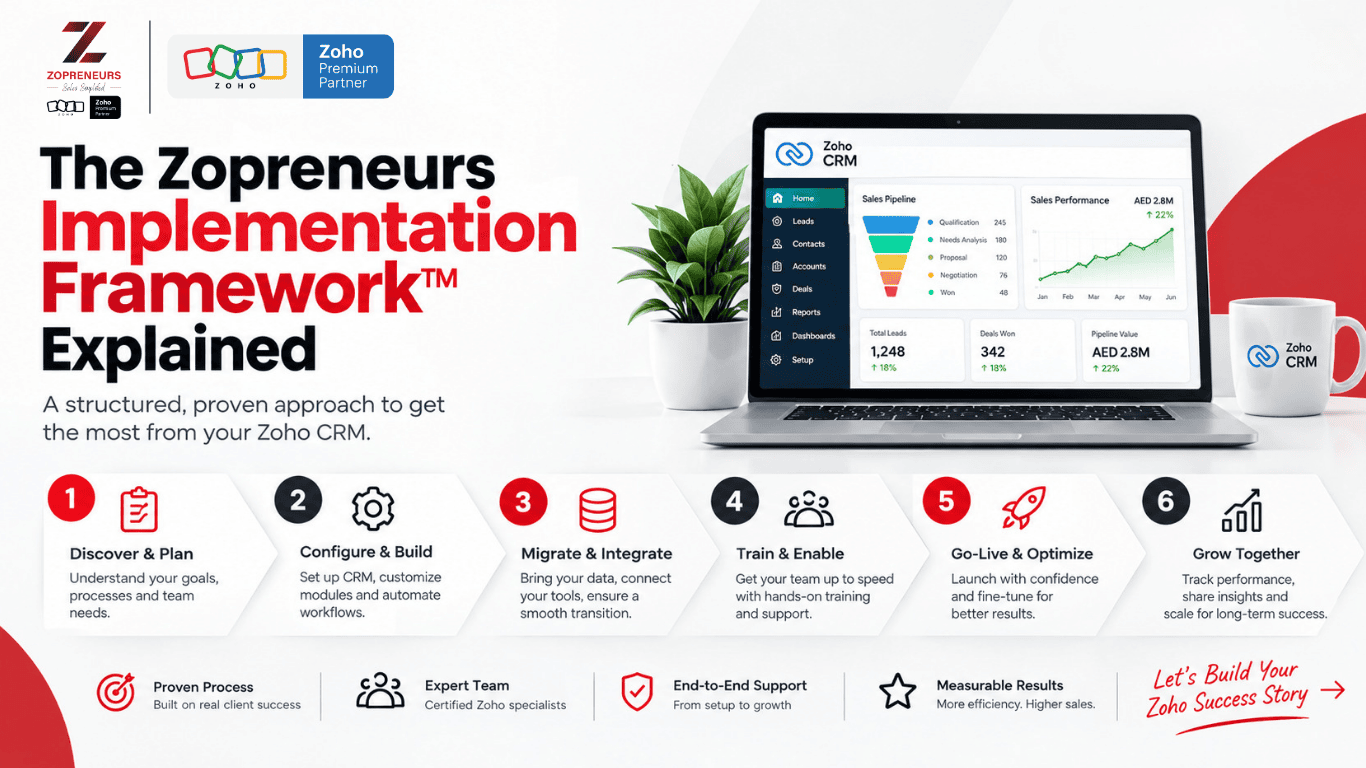
This is where the Zopreneurs Implementation Framework™ comes in.
At Zopreneurs, we approach Zoho implementations with a process-first mindset. Instead of asking, “How do we configure Zoho CRM?”, we start with a more important question:
“How should this business operate, and how can Zoho support that journey?”
The Zopreneurs Implementation Framework™ brings this thinking into a structured implementation process designed to connect business processes, people, technology, automation, and reporting.
What Is the Zopreneurs Implementation Framework™?
The Zopreneurs Implementation Framework™ is our structured approach to designing and implementing Zoho solutions around the way a business actually works.
Every business has different:
- Sales processes
- Customer journeys
- Team structures
- Approval processes
- Reporting requirements
- Automation needs
- Data requirements
A CRM should reflect those differences.
Our framework focuses on understanding the business first and then translating those requirements into a practical Zoho environment.
The result is not simply a configured CRM.
It is a system designed to support the business journey from lead to customer and beyond.
Why a Framework Matters in CRM Implementation
Many CRM implementations begin with features.
Businesses may start asking:
“Can Zoho CRM do this?”
“Can we automate this?”
“Can we create a dashboard for this?”
These are useful questions, but they should come after understanding the underlying process.
For example, if a sales team receives an enquiry, qualifies it, schedules a meeting, sends a proposal, negotiates, and closes the deal, the CRM should support each of those stages.
If the process itself is unclear, simply adding fields, workflows, and automation can make the system more complicated rather than more useful.
A framework helps keep the implementation connected to business objectives.
The Zopreneurs Implementation Framework™
Our framework can be viewed through several key stages.
1. Discover
Every implementation begins with understanding the business.
This involves looking beyond the software and understanding how the organisation currently operates.
We examine areas such as:
- Current business processes
- Sales journey
- Customer journey
- Team roles
- Existing systems
- Data sources
- Communication channels
- Current challenges
- Reporting requirements
- Automation opportunities
The objective is to understand what is happening today before designing what should happen tomorrow.
Why Discovery Matters
A CRM implementation built on assumptions can quickly become disconnected from the people expected to use it.
Discovery gives the implementation team a clearer picture of the real-world process.
It also helps identify opportunities to simplify processes before they are transferred into the system.
2. Design
Once the business process is understood, the next step is designing the CRM experience.
This is where business requirements are translated into a structured system.
The design may include:
- Modules
- Fields
- Sales stages
- Lead statuses
- Workflows
- User roles
- Permissions
- Approval processes
- Notifications
- Integrations
- Reports
- Dashboards
But the focus remains on the business process.
For example, instead of simply creating a “Deal Stage” field, the implementation should establish what each stage means, what information is required at each stage, and what actions should happen when a deal moves forward.
This creates a CRM that supports a defined sales process rather than simply storing information.
3. Build
Once the architecture is defined, the system can be configured.
This is where the implementation moves from strategy into execution.
Depending on the requirements, the build may include:
- CRM configuration
- Custom fields and modules
- Workflow automation
- Email automation
- Assignment rules
- Validation rules
- Approval workflows
- Custom functions
- Integrations
- Dashboards
- Reports
- Data structures
The objective is to build a system that is practical for everyday use.
A technically impressive CRM is not necessarily a successful CRM if the sales team finds it difficult to use.
4. Automate
Automation is an important part of modern CRM implementation.
But automation should solve a problem rather than simply exist because a feature is available.
For example, a business may want to automate:
Lead Assignment
When a new lead enters the CRM, it can automatically be assigned to the appropriate salesperson.
Follow-Ups
Tasks or reminders can be created when a lead requires action.
Email Communication
Relevant emails can be triggered based on defined customer or sales activities.
Internal Notifications
Teams can receive alerts when important events occur.
Approvals
Specific actions can be routed through approval workflows when required.
Good automation reduces repetitive manual work while helping teams follow the intended process consistently.
5. Integrate
Businesses rarely operate with one application.
They may use different systems for:
- Accounting
- Marketing
- Customer support
- Communication
- HR
- Projects
- Payments
- Documents
A CRM becomes more useful when relevant systems can work together.
Depending on the business requirements, the implementation may involve integrating Zoho CRM with other Zoho applications or third-party platforms.
The objective is to reduce disconnected information and unnecessary manual data entry.
Instead of teams repeatedly moving information between systems, the right integrations can help create a more connected business environment.
6. Migrate
CRM implementation often involves existing data.
That data may currently live in:
- Excel spreadsheets
- Legacy CRM systems
- Accounting software
- Separate databases
- Multiple files
- Individual team records
Moving this information into the new CRM requires more than simply importing a spreadsheet.
Data may need to be:
- Reviewed
- Cleaned
- Deduplicated
- Standardised
- Mapped
- Validated
- Imported
Good data migration helps ensure that the new CRM starts with reliable information.
7. Validate
Before the system goes live, it needs to be tested against the actual business process.
This includes checking whether:
- Leads are being captured correctly
- Records are assigned correctly
- Workflows trigger as expected
- Emails are sent at the right time
- Automations perform correctly
- Permissions are appropriate
- Reports display the required information
- Integrations transfer data correctly
User testing is particularly important.
The people who will use the CRM every day should be able to work through real scenarios and identify anything that needs adjustment.
8. Train
Even a well-designed CRM can fail if users don't understand how to use it.
Training should therefore be based on the team's actual workflow.
Instead of teaching users every available CRM feature, training should focus on what they need to do in their daily roles.
For example:
Sales representatives may need to know how to manage leads, update opportunities, complete follow-ups, and maintain customer information.
Managers may need to understand dashboards, pipeline visibility, reports, and performance tracking.
Administrators may need deeper knowledge of configuration and system management.
Role-based training makes adoption more practical.
9. Launch & Optimise
Implementation doesn't necessarily end when the CRM goes live.
Once users begin working in the system, new insights often emerge.
A workflow may need adjustment.
A report may need additional information.
A field may no longer be necessary.
A team may identify a new automation opportunity.
This is why optimisation is an important part of the framework.
The CRM should evolve as the business evolves.
The Framework Is About More Than Zoho
The Zopreneurs Implementation Framework™ is ultimately not about configuring a particular application.
It is about creating a connection between:
Business Process → People → Technology → Automation → Data → Insights
When these elements work together, the CRM becomes more than a database.
It becomes part of the way the business operates.
From Implementation to Business Enablement
A CRM implementation should make it easier for teams to do their jobs.
Sales teams should have visibility into their opportunities.
Managers should have access to meaningful reports.
Leaders should be able to understand business performance.
Customers should experience a more consistent journey.
And teams should spend less time on repetitive administrative work.
This is the difference between simply implementing software and designing a system around a business.
Why Zopreneurs Takes a Process-First Approach
At Zopreneurs, we believe technology should adapt to the business — not the other way around.
Our approach starts with understanding the customer journey, the internal process, and the information the business needs to make decisions.
From there, we translate those requirements into a structured Zoho environment.
The goal is simple:
Build a system your team can actually use, your managers can actually understand, and your business can actually grow with.
Ready to Build a CRM Around Your Business?
If your CRM feels disconnected from the way your team actually works, the problem may not be the software.
It may be the implementation approach.
The Zopreneurs Implementation Framework™ is designed to bring together process discovery, CRM design, automation, integration, data migration, training, and optimisation into one structured journey.
Want to build a Zoho system around the way your business actually works?
Talk to Zopreneurs today and let’s design a CRM implementation that supports your process, your people, and your growth.