
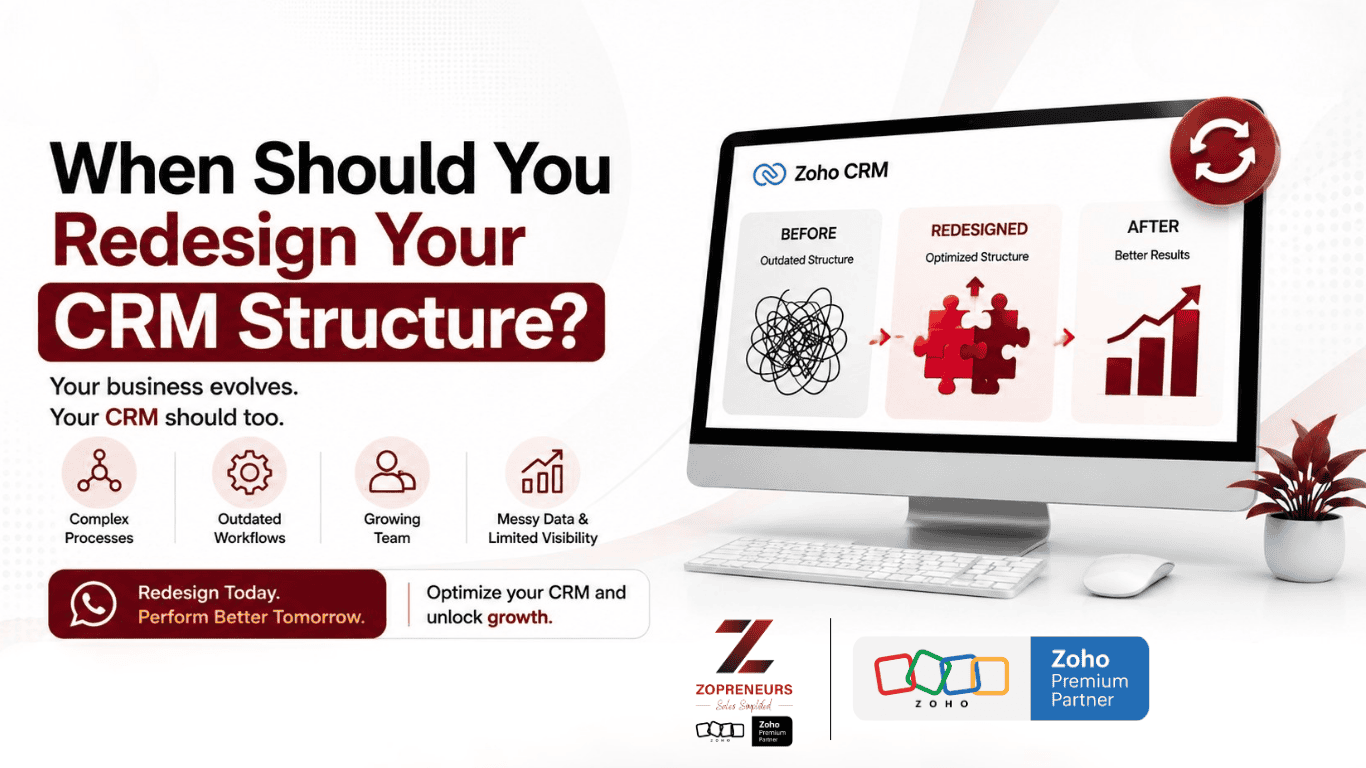
Your CRM should help your business grow—not slow it down.
Many businesses invest in a CRM system expecting better sales, improved customer relationships, and streamlined operations. But over time, as your business evolves, your CRM structure may no longer support the way your teams work.
If your sales team is spending more time updating records than closing deals, or if your reports don't reflect the reality of your business, it may be time for a CRM redesign.
In this blog, we'll explore the key signs that indicate your CRM needs restructuring and how a well-designed CRM can improve productivity, customer experience, and revenue.
Why Your CRM Structure Matters
A CRM isn't just a database—it's the backbone of your sales, marketing, and customer service operations.
As your company grows, you may introduce new products, expand into new markets, add departments, or automate more business processes. If your CRM structure isn't updated to match these changes, it can quickly become inefficient.
A properly designed CRM helps you:
Improve sales productivity
Automate repetitive tasks
Track leads more accurately
Generate meaningful reports
Enhance customer experience
Scale your business with confidence
1. Your Team Is Creating Workarounds
One of the biggest warning signs is when employees start creating spreadsheets outside the CRM or maintaining duplicate records.
If your team constantly says:
"The CRM doesn't support this."
"It's easier to track this in Excel."
"We have another sheet for this."
Your CRM structure is likely no longer aligned with your business process.
2. Reports Don't Give Useful Insights
A CRM should help management make better decisions.
If your dashboards show inaccurate numbers, duplicate data, or incomplete information, your CRM structure probably needs an overhaul.
Common reporting issues include:
Missing sales stages
Inconsistent lead sources
Duplicate contacts
Incorrect forecasting
Inaccurate revenue tracking
Better CRM architecture creates cleaner data and more reliable reporting.
3. Your Sales Process Has Changed
Businesses evolve.
Maybe you've added:
Multiple sales teams
Different service offerings
Subscription models
Regional offices
New approval workflows
If your CRM still follows the process you had years ago, it's holding your business back.
Your CRM should reflect how your business operates today—not how it operated when it was first implemented.
4. Automation Has Become Difficult
Modern businesses rely heavily on CRM automation.
If creating simple workflows now requires complex workarounds, your CRM structure may be the problem—not the software.
A redesigned CRM allows you to automate:
Lead assignments
Follow-up reminders
Email sequences
Approval processes
Customer onboarding
Renewal reminders
Invoice notifications
The cleaner the CRM structure, the easier automation becomes.
5. Users Avoid Using the CRM
Low CRM adoption is often a design problem rather than a people problem.
If employees avoid updating records or complain that the system is confusing, consider reviewing:
Field layouts
Module structure
Page layouts
Navigation
Required fields
User permissions
A user-friendly CRM encourages adoption and improves data quality across the organization.
6. Duplicate or Poor-Quality Data Is Increasing
Bad CRM structure leads to bad data.
Over time, duplicate records, inconsistent naming conventions, and incomplete information make it difficult to trust the CRM.
A CRM redesign helps standardize:
Customer records
Lead management
Account hierarchy
Data validation rules
Mandatory information
Clean data leads to smarter business decisions.
7. Your Business Has Scaled
Many businesses begin with a simple CRM setup.
As they grow, they require:
Multiple pipelines
Territory management
Custom modules
Advanced analytics
Integration with accounting systems
WhatsApp integration
Marketing automation
AI-powered lead scoring
If your CRM hasn't evolved alongside your business, now is the right time to redesign it.
Benefits of Redesigning Your CRM
A modern CRM structure delivers measurable improvements across your business.
Benefits include:
Faster sales cycles
Improved customer experience
Better team collaboration
More accurate reporting
Increased CRM adoption
Reduced manual work
Scalable automation
Higher sales productivity
Instead of forcing your team to adapt to an outdated CRM, redesign your CRM to support your business goals.
Why Choose the Right CRM Implementation Partner?
Redesigning a CRM isn't just about adding fields or changing layouts.
It requires understanding your sales process, customer journey, reporting requirements, and automation opportunities.
Working with an experienced CRM consulting partner ensures your CRM is designed for long-term growth rather than short-term fixes.
Whether you're using Zoho CRM or planning a new implementation, investing in CRM optimization today can save hundreds of hours of manual work in the future.
Final Thoughts
Your CRM should grow with your business.
If you're experiencing poor reporting, manual work, low user adoption, or increasing complexity, these are strong indicators that it's time to redesign your CRM structure.
A well-structured CRM empowers your team to sell faster, serve customers better, and make smarter business decisions.
Don't wait until inefficiencies start affecting your revenue. A strategic CRM redesign can transform the way your business operates.
Ready to Transform Your CRM?
At Zopreneurs, we're proud to be Zoho's Premium Partner, helping businesses across the UAE and beyond design CRM systems that drive growth, improve efficiency, and automate repetitive work.
Whether you need a complete CRM redesign, workflow automation, AI-powered sales processes, or a fresh Zoho CRM implementation, our experts are here to help.
Book a free CRM consultation and discover how a smarter CRM structure can help you close more deals, improve team productivity, and scale your business with confidence.